Basic Use
Nexus Pipeline for analyzing the effects of baryonic matter on cosmological structures in IllustrisTNG simulations
The PyCosmoMMF package contains the algorithms necessary for a Multiscale
Morphological Analysis (MMF) of cosmological simulations. The purpose of this
package is to streamline our modified version of the NEXUS+ algorithm. We used
the julia version of this package in our work
(Sunseri et al. 2022)
to analyze the effects of baryonic matter on the Cosmic Web.
The NEXUS+ algorithm contains several steps as described in our paper
(Sunseri et al. 2022).
In general, we start with a density field (note: we more specifically mean a 1 +
δ field), smooth it with a logarithmic Gaussian smoothing filter, then compute
the hessian of the smoothed density field, use the eigenvalues of the hessian
matrix to calculate the structure type signatures, find the maximum signatures
over a range of smoothing scales, and apply physically based threshold criterion
to categorize structures within the Cosmic Web. The entire package is
implemented in python and all of these steps are summarized inside of two
functions. The first function maximum_signature() does the first several steps
of the NEXUS+ algorithm to compute the maximum structure signatures, the second
function is calc_structure_bools() which uses physical criteria to tag
structures into 4 categories: clusters, filaments, walls, and voids.
We also make the data products from our paper (Sunseri et al. 2022) available for download at This Link
General Code Usage
The general usage of the package would look like:
Step I
We first calculate the maximum structure signatures across multiple smoothing scales with the NEXUS+/NEXUS algorithm
import PyCosmoMMF

density_field = np.load("path/to/density_field.npy")

Rs = [sqrt(2) ** n for n in range(10)]  # smoothing scales

max_signatures = PyCosmoMMF.maximum_signature(
    Rs, density_field, algorithm="NEXUSPLUS"
)  # compute maximum signatures
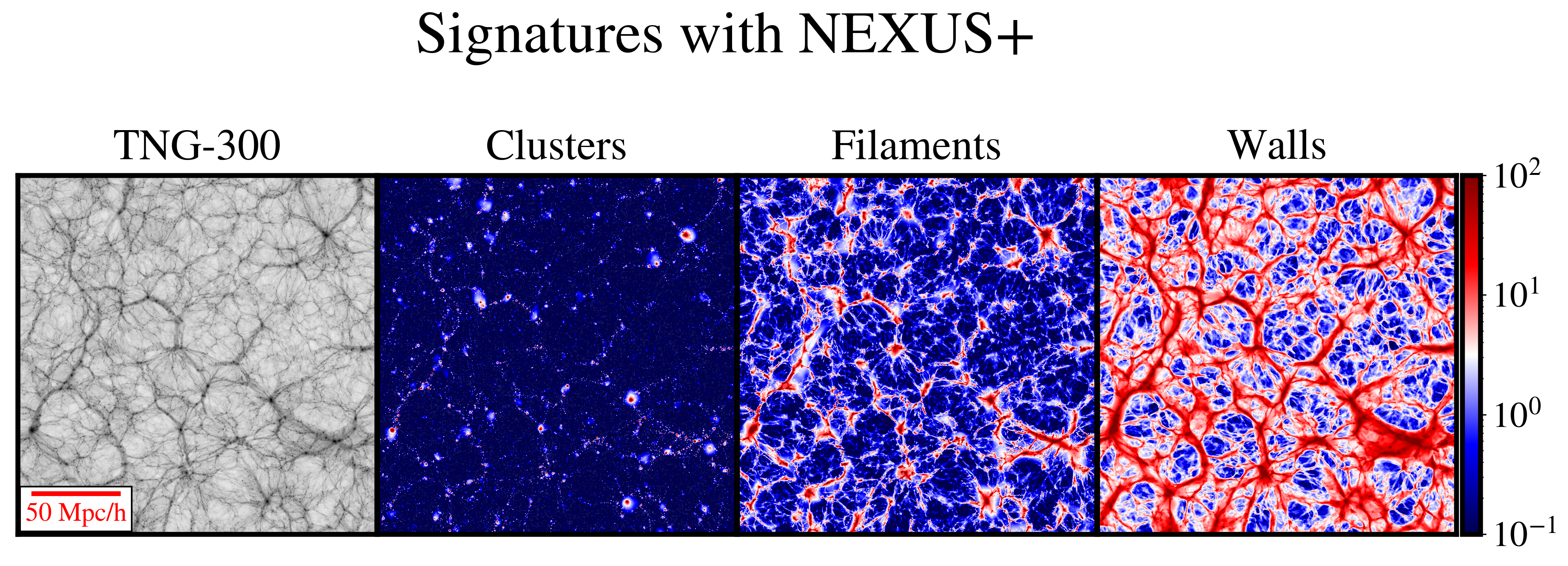
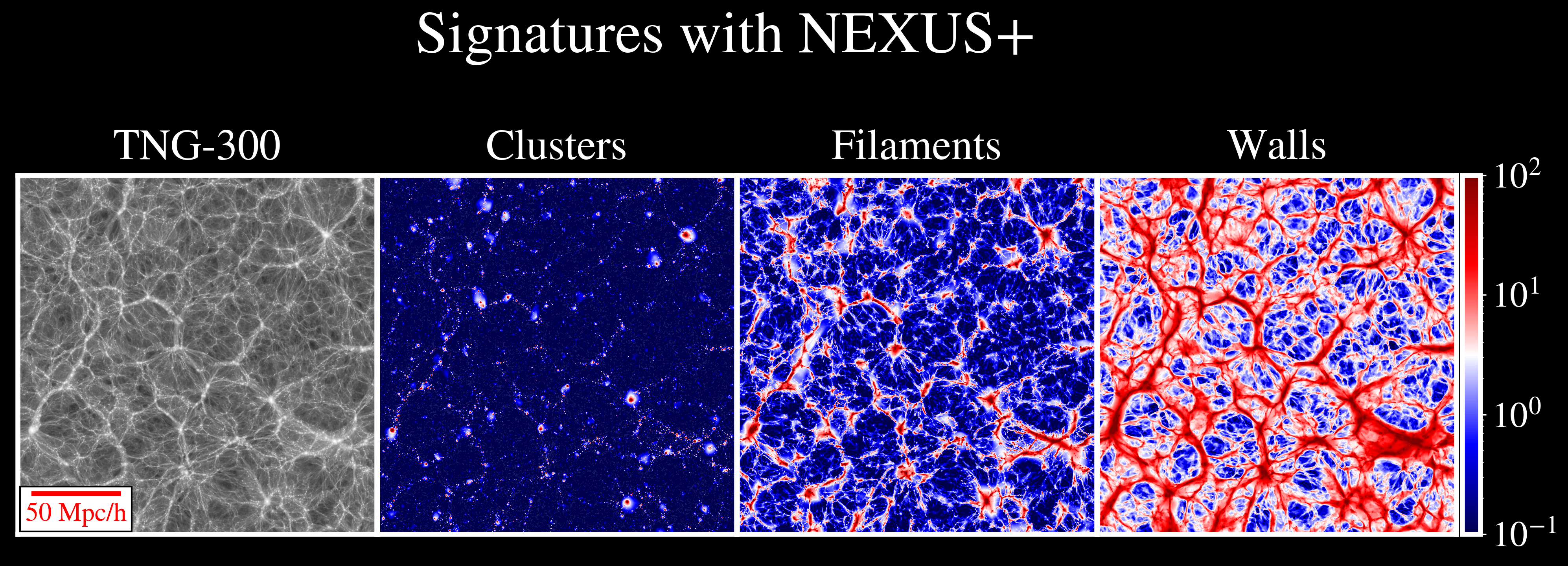
The output of maximum_signature() is a 4D Float Array where the 4th index
denotes the signature type: 0 = clusters, 1 = filaments, 2 = walls. An example
output of this can be seen below
Step II
We then have the option of running the tagging scheme a few different ways. The
first important argument in calc_structure_bools() besides the density_field
and the max_signatures arrays is the verbose_flag. When set to True the
code gives a lot more information and provides a few plots. This is best turned
on when debugging the code. When verbose_flag is turned on there is an
additional output to the calc_structure_bools() function: summary_data which
is a dictionary containing all the relevant extra information one might need. It
can be used to make the mass change curves for filaments and walls. Consult the
API Docs tab for a detailed summary of what is inside summary_data.
Verbose Flag On:
verbose_flag = True  # or False


clusbool, filbool, wallbool, voidbool, summary_data = PyCosmoMMF.calc_structure_bools(
    density_field, max_signatures, verbose_flag
)  # tag structures
Verbose Flag Off:
verbose_flag = False


clusbool, filbool, wallbool, voidbool = PyCosmoMMF.calc_structure_bools(
    density_field, max_signatures, verbose_flag
)  # tag structures
We also note in the calc_structure_bools() function, one can use their own
cluster boolean filter instead of the one generated by the NEXUS+ formalism
(using virialization of clusters as a tool for determining spurious detections).
This is helpful if you want to use a more trusted cluster/halo finder algorithm
(FoF, Rockstar, etc…). For more information on the NEXUS+ method, see
Cautun et al. 2013.
External Cluster Boolean Filter:
clusbool_ext = np.load(
    "path/to/cluster_boolean_filter.npy"
)  # load in externally computed boolean filter for clusters

verbose_flag = False


clusbool, filbool, wallbool, voidbool = PyCosmoMMF.calc_structure_bools(
    density_field, max_signatures, verbose_flag, clusbool_ext
)  # tag structures
Another important optional argument in the calc_structure_bools() function is
overdensity_threshold. The default value is overdensity_threshold = 370 as
used in
Cautun et al. 2013
but other values can be 200 or 500 corresponding to R_200 or R_500.
overdensity_threshold is the overdensity parameter Δ, when clusters achieve an
average overdensity greater than this value, they are thought to be
virialized/collapsed.
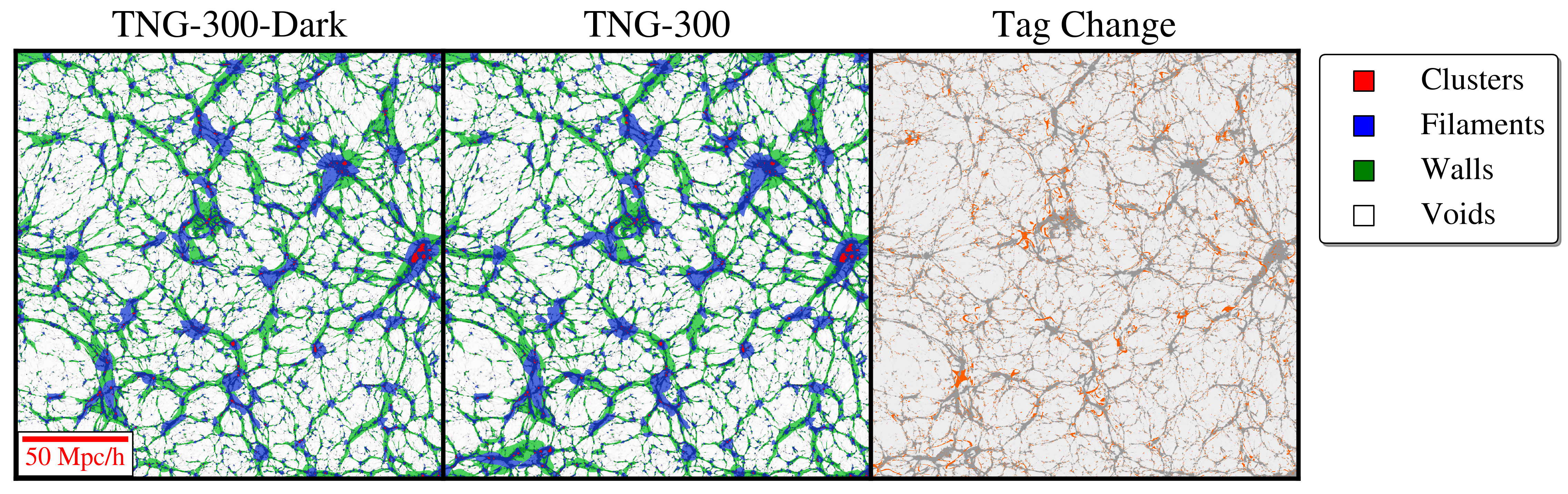
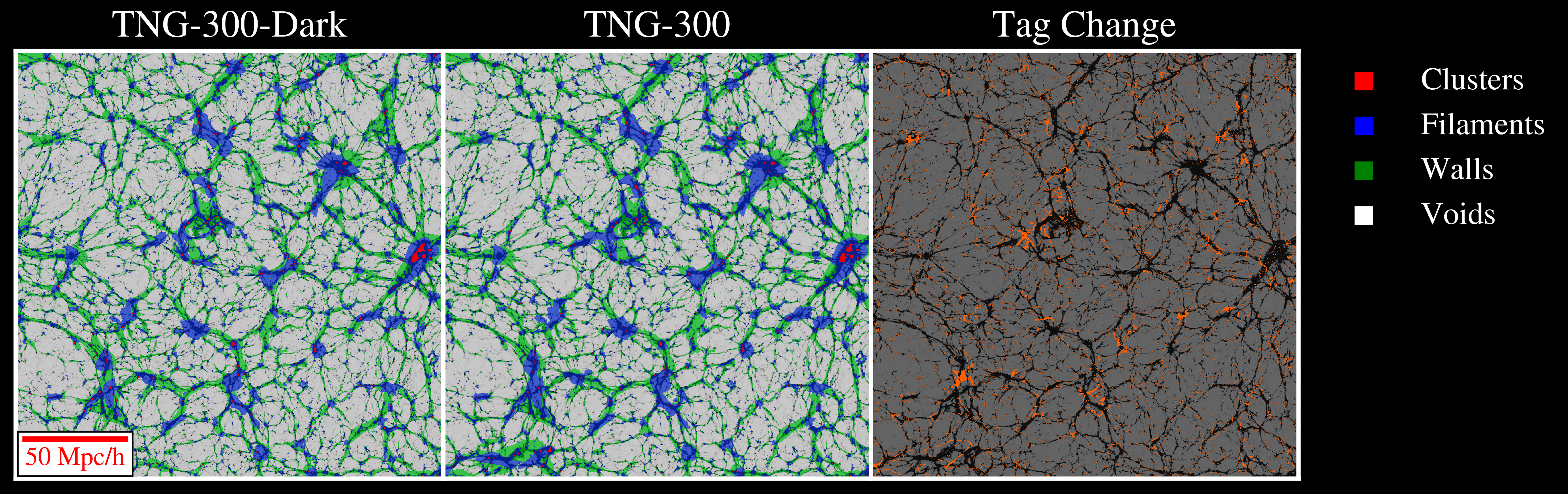
The boolean filters for each structure type produced by calc_structure_bools()
can be used to tag structures within a density field, the results of this can be
seen below
Additional Code Information
Note: The NEXUS+ implementation of tagging clusters is highly dependent on the the grid resolution being used. The cluster boolean filter will only be physically motivated if the resolution of each voxel is roughly < 1 Mpc/h so clusters can be resolved.